Pray Brethren

Pray Brethren
Showing posts with label Sacraments. Show all posts

Tuesday, December 18, 2012

The Character-Giving Sacraments of Election and Representation

There are many ways to categorize the sacraments. The most common approach, as found in the Catechism of the Catholic Church, is to group Baptism, Confirmation, and Eucharist together as the “Sacraments of Initiation” while placing Holy Orders and Matrimony together as the “Sacraments of Service” and grouping Confession and Anointing together as the “Sacraments of Healing”. There are three sacraments (Baptism, Confirmation, and Holy Orders), however, that impart something unique: an indelible mark called a character. A character is a seal placed on the soul for all eternity – remaining even if one commits a mortal sin, loses all grace, and separates himself from God. Indeed, some theologians have postulated that the souls in hell who bear the divine seal will be signs of enhanced shame and the seal a cause of greater torment.

In each of the Sacraments of Baptism, Confirmation, and Holy Orders God elects us – chooses us, calls us, and draws us into and ordered orbit in and around His Son. These sacraments also give us a unique representational status – a representation culminating in Holy Orders through which those men God elects are so representational that when they speak in the sacraments they speak in Persona Christ, in the very person of Christ. Of these men, Jesus says: “Whoever hears you, hears me.” Thus, if we were to group these three character-giving sacraments together, we might call them the “Sacraments of Election and Representation”.


A helpful analogy for the unique electoral-representational character of these sacraments is the atom. As you may recall from science class, the atom is composed of a nucleus center (made of protons and neutrons) around which orbit elections. Free elections may be drawn into orbit around the nucleus and we typically find larger numbers of elections in the orbits (or “shells”) further away from the nucleus at the atom’s heart. While this is obviously not the complete story of atomic structure and interaction, it paints a useful picture for our understanding of the Sacraments of Election and Representation. Analogously speaking, our current depiction of the atom becomes a depiction of Jesus Christ the New Adam.


As the atom consists of the nucleus and its orbiting elections, the New Adam is found in both its nuclear head as well as its elect body. Unlike the Pauline head-body analogy, however, the atomic Adam, so to speak, offers us a further sacramental structure. As the atom draws free elections into its orbit, the New Adam elects and draws us into his outer orbit first and foremost through the Sacrament of Baptism. Baptism binds us to Christ in a similar way that elections enter into an orbit around the nucleus. What’s more, we who are among the elect and have been drawn into the New Adam through baptism now stand before God in Christ as the representatives of the human race.

Our bond is rendered more complete and perfect through the Sacrament of Confirmation, the next orbit towards the nucleus. And if Baptism makes us representatives in Christ of humanity, the Catechism teaches that Confirmation makes us “quasi-official representatives” of the Church, the body of Christ, in order to proclaim the Gospel and draw others into the atomic Adam. Or to use Biblical terms, the first born son is the father’s representative to the younger children and the younger children’s representative to the father. We who are joined to Christ through Baptism and Confirmation share in this role as adoptive sons in the one Son. Lastly, of those confirmed men, God elects a portion into the closest orbit, so close that they can uniquely speak and act in his name and he can act sacramentally through them.

While every image breaks down at some point, the "New Adam-atom" nevertheless offers us another way to examine the unique character (no pun intended) of Baptism, Confirmation, and Holy Orders, while also helping us take another look at those two central - yet often overlooked - categories of Christian theology: election and representation.

Monday, July 16, 2012

Receiving Communion in the Hand

When considering the possibility of Communion received in the hand rather than on the tongue, the Holy See pointed out “certain dangers” of such a change. These included: “the danger of a loss of reverence for the august sacrament of the altar, of profanation, of adulterating the true doctrine.” But given that several bishops in Europe had already begun implementing this change illicitly, Pope Paul VI decided to take a vote on the matter rather than stomping it out altogether. Two-thousand bishops across the globe were polled and the results were as follows:
  • 59% of bishops said the laity of their diocese would not accept the new practice.
  • 62% of bishops did not want to see the practice begin in their diocese.
  • 66% of the bishops didn’t think the practice was worth addressing.
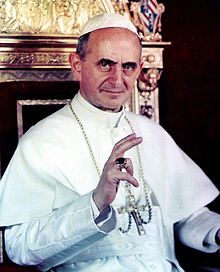
Despite the vote, in 1969 Pope Paul VI decided to
Pope Paul VI (pictured above) and
his successors never accepted
Communion in the hand. The pope's
compromise was to tolerate the
illicitly established practice via
indult in the places where it was
already in use while barring its
practice elsewhere.
strike a compromise with his disobedient bishops on the continent. Given “the gravity of the matter,” the pope would not authorize Communion in the hand. He was, however, open to bestowing an indult – an exception to the law – under certain conditions: first, an indult could not be given to a country in which Communion in the hand was not an already established practice; second, the bishops in countries where it was established must approve of the practice “by a secret vote and with a two-thirds majority.” Beyond this, the Holy See set down seven regulations concerning communion in the hand; failure to maintain these regulations could result in the loss of the indult. The first three regulations concerned: respecting the laity who continue the traditional practice, maintaining the laity’s proper respect of the Eucharist, and strengthening the laity’s faith in the real presence.
 
So how did Communion in the hand come to America?

In 1975 and again in 1976, Joseph Bernardin, the Archbishop of Chicago and president of the National Conference of Catholic Bishops (NCCB) attempted in vain to garner two-thirds of the bishops to vote in favor of receiving Communion in the hand. The following year – which coincided with the end of Bernadin’s term as president – brought one final attempt. Bernadin appointed Archbishop Quinn, who became Bernadin immediate successor as NCCB president, to be the chief lobbyist for Communion
Communion in the hand
was certainly in the 'spirit'
of Cardinal Bernadin.
in the hand. During the proceedings a brave bishop requested a survey of the bishops be taken – this survey would ask each bishop whether or not Communion in the hand was widely practiced in his diocese, for without the practice’s current wide-use the first condition of the indult would not be satisfied.

Of course, everyone knew that Communion in the hand was not a previously established practice in the United States.

Though his request was seconded and supported in writing by five other bishops, Bernadin had the motion dismissed as “out of order”. The bishops then voted... only to once more fall short of the two-thirds majority. This, however, did not end the matter. Bernadin decided to begin gathering “absentee votes” from any bishop he could find – including retired bishops who no longer administered any dioceses. Consequently, the number was adjusted to meet the two-thirds majority so that one of Bernadin’s final acts as NCCB president was to disregard the will of the Holy Father and introduce Communion in the hand to U.S. Catholics.

Through the heavy-handed politcal maneuvering of Cardinal Bernadin, Pope Paul VI’s attempt to create a firewall preventing the spread of Communion in the hand had failed.

Monday, June 27, 2011

Protestants and Ordained Female Ministers

Today I came across an interesting paper regarding the ordination of women to the priesthood. It was written by Sr. Sara Butler. At first I wasn't sure which side of the issue she would defend, but as it turns out she supports the teaching of the Catholic Church. While she does a pretty good job of explaining the Church's view, the official reasoning of the Magisterium could use some more support (in my humble opinion).

That being said, this post is actually about Protestantism rather than Catholicism.

Sr. Sara pointed out that many people have shown that Protestants have female ministers, so why not Catholics. If we are all Christians, why is the Catholic Church so "anti-woman"? Of course, a good Catholic should quickly point out that the greatest of all God's creatures is a woman whose name is Mary, the Mother of God, but there is something to be said about how Protestant theology differs from Catholic theology regarding sacraments. As Sr. Sara writes:

It is well known that the 16th century Reformers denied that Holy Orders is a sacrament. This difference, then, touches the origins of the ministry (that is, its institution by Jesus Christ), its relationship to the office of the Twelve Apostles (and therefore to apostolic succession), and its relationship to the common priesthood (or priesthood of the baptized). To put it simply, it is not because we differ over the equality and complementarity of the sexes that some Protestants ordain women, and the Catholic Church does not; it is because we disagree over whether Holy Orders is a sacrament.

How does this disagreement impinge on our question? First, according to Catholic teaching, Holy Orders is a sacrament distinct from Baptism that confers on one of the baptized a sacred power not possessed by the rest. This is what is meant by saying that the ministerial priesthood differs in kind and not just in degree from the common priesthood of the baptized. According to the Protestant Reformers, by contrast, ordination commits to the minister, for the sake of good order and on the basis of his or her spiritual gifts, the exercise of functions that in principle belong to all of the baptized. The Reformers held that the “general ministry” of Word and Sacrament is given first to the whole Church, and then transmitted by ordination to those who will serve the rest in the “special ministry.” What follows from this? According to the classical Reformation doctrine, it is indeed unjust to bar baptized women from the ministry on the basis of their sex. The slogan, “If you won’t ordain women, don’t baptize them” makes sense in denominations that adhere to this doctrine.


In other words, Baptism is one's official entry into the body of believers called the Church. But for Catholics, God calls some men from within the body of believers to perform certain duties in His name and represent us before the Father. Furthermore, of these men there is a hierarchy of deacon, priest, and bishop. Protestantism, on the other hand, is ecclesially-speaking rather flat and egalitarian. Add to this the Protestant notion that all receive the same amount of grace (a grace which merely covers the soul, not inheres in the soul) and we have a communion of saints where no saint is any holier than the next. Very flat indeed.

But in this present conversation we can say that the sacramental status of Holy Orders makes all the difference between Catholic and Protestant thinking on the matter. If Christ called twelve men into a body called the Apostles and conferred on them the fullness of his own mission through Holy Orders (keeping in mind this calling came prior to the established mission to baptize), then their successors maintain that mission and draw other men into their body in order to further carry out the mission of Christ. By flattening out the nature of grace and the Church, Protestantism lost a vital icon of masculinity. Combine with this the rejection of Marian dogma and we see a Protestantism that is as disoriented as homosexuality, and absolutely confused over gender roles.

Keep in mind that these words are not to be in harsh criticism of Protestantism; rather, I hope Protestantism sees the help the Catholic Church could be on this matter. Furthermore, I would argue that Protestantism not only helped Catholics see the the importance of the separation of church and state, but it also helped establish the first modern nations including my beloved nation, the United States. I also thank Protestantism for helping me pick up my Bible in study and prayer. But if Protestantism can help Catholics get more Biblical, perhaps its time we help it become more sacramental.

In the end it's far easier to handle social issues when you have the Bible and Sacraments.