Pray Brethren

Pray Brethren
Showing posts with label Papal. Show all posts

Tuesday, October 8, 2013

The Pope of Christian Unity and the Unity of Faith

Pope Benedict XVI may well be known as the Pope of Christian Unity. In his short pontificate, he not only advanced an unparalleled dialogue with the Orthodox churches, but he also found a way for Anglicans to return to full communion without losing their rich liturgical heritage while also liberalizing the use of the Latin Mass for Catholics who wish to share in its timeless beauty and power.

In his writings, however, Pope Benedict contrasts the unitive and social character of faith with the individual character of philosophy:
“One could say epigrammatically that faith does in fact come from ‘hearing’, not – like philosophy – from reflection. Its nature lies in the fact that it is not the thinking out of something that can be thought out and that at the end of the process is then at my disposal as a result of my thought. On the contrary, it is characteristic of faith that it comes from hearing, that it is the reception of something that I have not thought out, so that in the last analysis thinking in the context of faith is always a thinking over of something previously heard and received.”

“In philosophy, the thought precedes the word; it is after all a product of the reflection that one then tries to put into words; the words always remain secondary to the thought and thus in the last resort can be replaced by other words. Faith, on the other hand, comes to man from the outside, and this very fact is fundamental to it. It is---let me repeat----not something thought up by myself; it is something said to me… and lays and obligation on me.”

Philosophy arises out of an “essentially individualistic structure” and is “by its nature the work of a solitary individual, who ponders as an individual on truth.” The philosopher’s thought or reflection “only becomes communicable later, when it is put into words, which usually make it only approximately comprehensible to others.

“In philosophy, what comes first is the private search for truth, which then, secondarily, seeks and finds a travelling companion. Faith, on the other hand, is first of all a call to community, to unity of mind through the unity of the word. Indeed, its significance is, a priori, an essentially social one: it aims at establishing unity of mind through the unity of the word. Only secondarily will it then open the way for each individual’s private venture in search of truth.”

Monday, July 16, 2012

Receiving Communion in the Hand

When considering the possibility of Communion received in the hand rather than on the tongue, the Holy See pointed out “certain dangers” of such a change. These included: “the danger of a loss of reverence for the august sacrament of the altar, of profanation, of adulterating the true doctrine.” But given that several bishops in Europe had already begun implementing this change illicitly, Pope Paul VI decided to take a vote on the matter rather than stomping it out altogether. Two-thousand bishops across the globe were polled and the results were as follows:
  • 59% of bishops said the laity of their diocese would not accept the new practice.
  • 62% of bishops did not want to see the practice begin in their diocese.
  • 66% of the bishops didn’t think the practice was worth addressing.
Despite the vote, in 1969 Pope Paul VI decided to
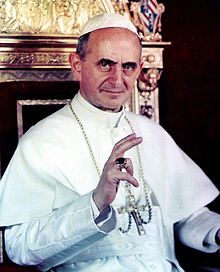
Pope Paul VI (pictured above) and
his successors never accepted
Communion in the hand. The pope's
compromise was to tolerate the
illicitly established practice via
indult in the places where it was
already in use while barring its
practice elsewhere.
strike a compromise with his disobedient bishops on the continent. Given “the gravity of the matter,” the pope would not authorize Communion in the hand. He was, however, open to bestowing an indult – an exception to the law – under certain conditions: first, an indult could not be given to a country in which Communion in the hand was not an already established practice; second, the bishops in countries where it was established must approve of the practice “by a secret vote and with a two-thirds majority.” Beyond this, the Holy See set down seven regulations concerning communion in the hand; failure to maintain these regulations could result in the loss of the indult. The first three regulations concerned: respecting the laity who continue the traditional practice, maintaining the laity’s proper respect of the Eucharist, and strengthening the laity’s faith in the real presence.
 
So how did Communion in the hand come to America?

In 1975 and again in 1976, Joseph Bernardin, the Archbishop of Chicago and president of the National Conference of Catholic Bishops (NCCB) attempted in vain to garner two-thirds of the bishops to vote in favor of receiving Communion in the hand. The following year – which coincided with the end of Bernadin’s term as president – brought one final attempt. Bernadin appointed Archbishop Quinn, who became Bernadin immediate successor as NCCB president, to be the chief lobbyist for Communion
Communion in the hand
was certainly in the 'spirit'
of Cardinal Bernadin.
in the hand. During the proceedings a brave bishop requested a survey of the bishops be taken – this survey would ask each bishop whether or not Communion in the hand was widely practiced in his diocese, for without the practice’s current wide-use the first condition of the indult would not be satisfied.

Of course, everyone knew that Communion in the hand was not a previously established practice in the United States.

Though his request was seconded and supported in writing by five other bishops, Bernadin had the motion dismissed as “out of order”. The bishops then voted... only to once more fall short of the two-thirds majority. This, however, did not end the matter. Bernadin decided to begin gathering “absentee votes” from any bishop he could find – including retired bishops who no longer administered any dioceses. Consequently, the number was adjusted to meet the two-thirds majority so that one of Bernadin’s final acts as NCCB president was to disregard the will of the Holy Father and introduce Communion in the hand to U.S. Catholics.

Through the heavy-handed politcal maneuvering of Cardinal Bernadin, Pope Paul VI’s attempt to create a firewall preventing the spread of Communion in the hand had failed.

Sunday, July 15, 2012

The Language of Christianity’s Future

Cardinal Arinze with his longtime friend and ecclesial brother, Pope Benedict XVI.
The great Nigerian prelate Cardinal Arinze is not only one man every Catholic should know, he’s also from a country every American know. As Christianity becomes more and more a religion of the global south, the voice of Cardinal Arinze is the voice of the near Christian future. And as Nigeria is divided between the Islamic north and Christian south, its ongoing civilizational, religious, and cultural contest provides us with a microcosm of unfolding global events to come.

If you are not familiar with Cardinal Arinze – or with the voice of Christianity still shaped by authoritative masculine personalities – here are some Arinze quotes which should help:

On the Family: "In many parts of the world, the family is under siege. It is opposed by an anti-life mentality as is seen in contraception, abortion, infanticide, and euthanasia. It is scorned and banalized by pornography, desecrated by fornication and adultery, mocked by homosexuality, sabotaged by irregular unions and cut in two by divorce."

On Atheists: "If a child refuses to accept its father or mother, that child is not a liberal, that child is a brat. And how much more important is God to us than a parent to a child?"

On Pro-Choice Politicians and the Eucharist: "You don't need a Cardinal to answer that question. You can ask a seven year old getting ready for First Communion and they will say no. Personally opposed! Ok, you tell them, I am personally opposed but if someone wants to come in here and shoot you all, well... It's pro choice."

On Female Servers: "Some bishops have asked about this and… we said, 'It's alright.' ... But if I had my way you know what I would do."
This is the language of Christianity’s future. It is a return not merely to “traditional Christianity” but rather a return to authoritative masculine speech (i.e. the kind of speaking we hear from foreign priests and very rarely from American-born priests). As Matthew says of Jesus, so too must we be able to say of a priest or bishop: “he taught [us] as one having authority” (Matthew 7:29). Moreover, the priestly vocation is not to speak with scholarly authority but with fatherly authority. Cardinal Arinze does just that – and that’s why he, as a celibate virgin, can truly be called “father”.