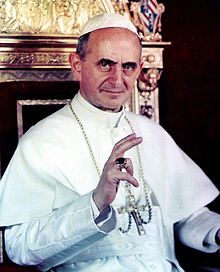
When considering the possibility of Communion received in the hand rather than on the tongue, the Holy See pointed out “certain dangers” of such a change. These included: “the danger of a loss of reverence for the august sacrament of the altar, of profanation, of adulterating the true doctrine.” But given that several bishops in Europe had already begun implementing this change illicitly, Pope Paul VI decided to take a vote on the matter rather than stomping it out altogether. Two-thousand bishops across the globe were polled and the results were as follows:
- 59% of bishops said the laity of their diocese would not accept the new practice.
- 62% of bishops did not want to see the practice begin in their diocese.
- 66% of the bishops didn’t think the practice was worth addressing.
Despite the vote, in 1969 Pope Paul VI decided to
 |
Pope Paul VI (pictured above) and
his successors never accepted
Communion in the hand. The pope's
compromise was to tolerate the
illicitly established practice via
indult in the places where it was
already in use while barring its
practice elsewhere. |
strike a
compromise with his disobedient bishops on the continent. Given “the gravity of the matter,” the pope would not authorize Communion in the hand. He was, however, open to bestowing an indult – an exception to the law – under certain conditions: first, an indult could not be given to a country in which Communion in the hand was not an already established practice; second, the bishops in countries where it was established must approve of the practice “by a secret vote and with a two-thirds majority.” Beyond this, the Holy See set down seven regulations concerning communion in the hand; failure to maintain these regulations could result in the loss of the indult. The first three regulations concerned: respecting the laity who continue the traditional practice, maintaining the laity’s proper respect of the Eucharist, and strengthening the laity’s faith in the real presence.
So how did Communion in the hand come to America?
In 1975 and again in 1976, Joseph Bernardin, the Archbishop of Chicago and president of the National Conference of Catholic Bishops (NCCB) attempted in vain to garner two-thirds of the bishops to vote in favor of receiving Communion in the hand. The following year – which coincided with the end of Bernadin’s term as president – brought one final attempt. Bernadin appointed Archbishop Quinn, who became Bernadin immediate successor as NCCB president, to be the chief lobbyist for Communion
 |
Communion in the hand
was certainly in the 'spirit'
of Cardinal Bernadin. |
in the hand. During the proceedings a brave bishop requested a survey of the bishops be taken – this survey would ask each bishop whether or not Communion in the hand was widely practiced in his diocese, for without the practice’s current wide-use the first condition of the indult would not be satisfied.
Of course, everyone knew that Communion in the hand was not a previously established practice in the United States.
Though his request was seconded and supported in writing by five other bishops, Bernadin had the motion dismissed as “out of order”. The bishops then voted... only to once more fall short of the two-thirds majority. This, however, did not end the matter. Bernadin decided to begin gathering “absentee votes” from any bishop he could find – including retired bishops who no longer administered any dioceses. Consequently, the number was adjusted to meet the two-thirds majority so that one of Bernadin’s final acts as NCCB president was to disregard the will of the Holy Father and introduce Communion in the hand to U.S. Catholics.
Through the heavy-handed politcal maneuvering of Cardinal Bernadin, Pope Paul VI’s attempt to create a firewall preventing the spread of Communion in the hand had failed.